Do you feel like artificial intelligence is an unreachable world reserved only for engineers and developers? The reality in 2026 is completely different. Thousands of people with no technical knowledge whatsoever are mastering artificial intelligence for beginners without programming and transforming how they work, study, and create.
This article is your practical roadmap. We’re not going to get lost in mathematical equations or confusing code. Instead, we’ll show you exactly how to learn AI without knowing how to program from scratch, with real tools you can use starting today, and a clear path that will take you from “what is AI?” to “how do I get the most out of it.”
If you’ve ever wondered where to start learning artificial intelligence without spending years on a technical degree, you’re in the right place. We’ll help you build a solid foundation, avoid costly distractions, and become an expert AI user in a matter of weeks.
| Learning Path | Estimated Time | Cost | Main Tools |
|---|---|---|---|
| Basic Foundations | 2-3 weeks | Free | YouTube, ChatGPT, Google AI Essentials |
| Practical Application | 4-6 weeks | Free-$49 | ChatGPT Plus, Claude Pro, Midjourney |
| Intermediate Specialization | 8-12 weeks | $50-300 | Coursera, Udemy, specialized platforms |
| Advanced Mastery | 3-6 months | $300-1000 | Certified programs, online bootcamps |
What is artificial intelligence and why do you need to learn it?
Before starting any AI course for beginners, you need to understand what we’re talking about. Artificial intelligence isn’t magic or science fiction. It’s simply a set of technologies that allow machines to perform tasks that normally require human intelligence.
Related Articles
→ Artificial intelligence for beginners 2026: learn from scratch without needing to program
In 2026, AI is everywhere: when your phone recognizes your face, when Netflix suggests a movie, when ChatGPT writes an email, or when a tool automatically edits a photo. All of these are artificial intelligence applications that you already use without thinking about it.
Why do you need to learn? Simple: understanding how AI works allows you to:
- Optimize your work: Automate repetitive tasks and gain hours each week
- Increase your creativity: Use generative AI tools to create content, images, and videos
- Make better decisions: Understand how data and algorithms influence your life
- Prepare for the future: AI skills are increasingly in demand in the job market
- Save money: Many tasks that once required freelancers you can now do with AI
The good news is that you don’t need programming. The latest advances in generative AI have democratized access. If you can write an email, you can learn to use AI.
The basic concepts you need to understand (without jargon)

To learn generative AI for beginners explained simply, we must first break down fundamental concepts. Here they are presented in a way anyone can understand.
Machine Learning: Learning from data
Imagine you want to teach someone to identify apples. Instead of giving them complicated rules about size, color, and shape, you show them thousands of photos of apples. Eventually, they learn to recognize them even in photos they’ve never seen.
That’s Machine Learning. The machine learns patterns from the data you provide, without you having to explicitly program each rule. It’s like training a dog: you repeat the behavior many times and eventually, the dog learns.
Neural Networks: The artificial brain
Neural networks mimic how our brains work. Your brain has billions of neurons connected. An artificial neural network has a similar structure: layers of “neurons” connected that process information.
What’s important? You don’t need to understand its internal structure. You just need to know they’re powerful tools that can learn complex patterns from data.
Generative AI: Creating new things
This is the most relevant concept for you as a beginner in 2026. Generative AI for beginners is the ability to create new content: text, images, code, music, videos.
ChatGPT, Claude, Midjourney, DALL-E… they’re all generative AIs. They take what they’ve learned from millions of examples and generate something completely new based on your instructions (prompts).
Prompt Engineering: The art of asking well
If generative AI is a powerful tool, prompt engineering is the most important skill you’ll learn. It’s simply the art of writing clear and specific instructions to get exactly what you want.
A weak prompt: “Write an email”
A strong prompt: “Write a professional 150-word email to my boss proposing a meeting about project X. Formal but friendly tone. Include 3 available dates.”
Step 1: Start with free tools (Week 1-2)
Get the best AI insights weekly
Free, no spam, unsubscribe anytime
No spam. Unsubscribe anytime.
You don’t need to spend money to get started. The free tools in 2026 are surprisingly powerful. This is the best starting point for how to learn AI without knowing how to program.
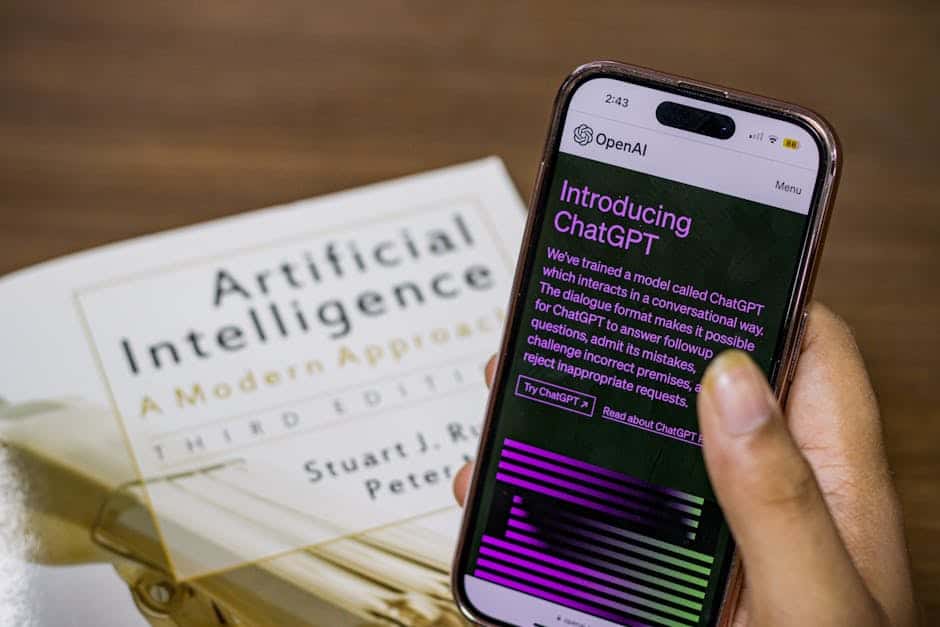
ChatGPT free version
Create an account at openai.com and start experimenting. Free ChatGPT has enormous capabilities. Try these initial exercises:
- Write 3 prompts to generate content ideas for your industry
- Ask it to summarize a complex article in simple language
- Request help structuring an important email
- Ask how to do something specific in your daily work
- Use the analysis function to interpret data
The goal: spend at least 30 minutes daily for two weeks playing with prompts. You’ll discover how it works, its limitations, and what it can and cannot do.
Google AI Essentials (FREE)
Google offers a completely free course called “AI Essentials” that teaches you basic concepts without programming. It lasts approximately 5 hours and gives you a certificate at the end.
Access at: grow.google/ai-essentials (available in multiple languages)
YouTube: Trusted channels
On YouTube you’ll find hundreds of creators explaining AI without jargon. Search for channels with more than 100k subscribers that specialize in “AI for beginners.” Spend 1-2 hours per week watching educational content.
Discord and Reddit communities
Join communities like r/OpenAI, r/ChatGPT, or Discord servers dedicated to AI. Here you’ll find people at your level learning together. Asking questions to a community is incredibly valuable.
Step 2: Learn to use specific tools (Week 3-6)
Once you understand the basic concepts, it’s time to dive deeper into specific tools. This is where you start seeing real, concrete results in your daily work.
ChatGPT Plus: Worth it ($20/month)
After 2-3 weeks with the free version, consider upgrading to ChatGPT Plus. It’s not mandatory, but it has advantages:
- Access to GPT-4, OpenAI’s most powerful model
- 5 times faster
- Priority access during peak hours
- Ability to use plugins and advanced analysis
- You can process complete documents (PDFs, images)
It’s a small investment that dramatically accelerates your learning. In our opinion, if you’re serious about learning AI, ChatGPT Plus is the best initial expense.
Claude (Anthropic): The versatile alternative
Claude is another excellent generative AI, with a free version and premium (Claude Pro, $20/month). Some prefer its interface, others its ability to work with very long texts.
Try both and stick with whichever aligns best with your style. The learning transfers between them: prompt engineering skills work for both.
Free specialized tools
- Canva AI: For design and visual editing (free version limited)
- Grammarly Free: AI-enhanced writing
- Perplexity AI: AI-powered search (better than Google for research)
- Leonardo.AI: Free image generation
- Kapwing AI: Video editor with AI
During weeks 3-6, choose 2-3 of these tools and master them. Do small projects: generate images for a personal project, improve your writing, research using AI.
Step 3: Formalize your learning with a course (Week 7-12)

At this point, you have practical experience. It’s the ideal time for an AI course for beginners that structures your knowledge. Here we differentiate between free and paid options.
Recommended FREE options
Google Cloud Skills Boost: Offers free labs on AI and ML. Access through grow.google
Coursera (free courses): Many universities offer free courses on Coursera. Search for “Artificial Intelligence for Everyone” by Andrew Ng. You can watch content for free (you only pay if you want a certificate).
Stanford Online: Stanford University offers free open courses on AI
Recommended paid options ($50-300)
If you can invest some money, these courses offer excellent value:
Coursera – AI for Everyone ($39-49 one-time): The most popular course for beginners. It’s by instructor Andrew Ng, a legend in AI. You can take the course free and pay only for the certificate.
Udemy – Specialized courses ($15-50 on sale): Udemy always has promotions. Search for courses with 4.8+ stars and more than 100k students. Some recommendations:
- “Complete AI and ChatGPT Bootcamp” – Lifetime access
- “AI Basics for Non-Programmers”
- “Midjourney Mastery for Beginners”
LinkedIn Learning (via subscription): If your company offers access or you have a premium subscription, there are structured AI courses
Which one to choose? Your decision matrix
Choose FREE if: You have free time, you’re self-taught, you prefer learning by exploring
Choose Coursera ($39-49) if: You want clear structure, backing from a famous university, you want a certificate
Choose Udemy ($15-50) if: You prefer learning by doing, you want lifetime access, you want specific specialization
Step 4: Specialize according to your goal (Month 3+)
Once you master the fundamentals, it’s time to decide where to start learning artificial intelligence in a specific direction. You don’t need to be a generalist. Choose a path:
Option A: Generative AI and Prompting
If your goal is to use AI in your daily work (marketing, writing, design, analysis), focus here.
- Master advanced prompt engineering
- Learn to use multiple tools (ChatGPT, Claude, Midjourney, etc.)
- Study real-world use cases in your industry
- Practice with small projects each week
Time: 4-8 weeks
Cost: $50-150
Best for: Freelancers, marketers, content creators, students
Option B: AI for Data Analysis
If you work with data and want to interpret it better, this path uses AI to extract insights.
- How to use AI to interpret large datasets
- Smart data visualization
- Basic predictions without programming
- Tools like Tableau, Power BI with AI assistants
Time: 6-12 weeks
Cost: $100-300
Best for: Analysts, entrepreneurs, project managers
Option C: Foundations toward AI Programming
If you eventually want to learn programming, start with concepts first, then gradually add programming.
- Complete this entire guide first (no code)
- Learn basic Python (easiest language)
- Take ML courses with Python on Coursera/Udemy
- Move on to deep learning if interested
Time: 4-6 months
Cost: $200-500
Best for: Those wanting tech careers, transitioning engineers
Practical AI tools you must master
These are the tools every beginner should know and practice. We include both free and premium options so you choose based on your budget.
Writing and Analysis Tools
- ChatGPT / ChatGPT Plus: Versatile AI, best for writing, analysis, brainstorming. Free and $20/month
- Claude / Claude Pro: Excellent for long texts, deep analysis. Free and $20/month
- Perplexity AI: AI-powered research, cites sources. Free with limitations
- Grammarly Free: Enhanced writing in real-time. Free
Image Tools
- DALL-E 3 (within ChatGPT Plus): Generates high-quality images. $20/month
- Midjourney: Best artistic quality, but requires Discord. $10-120/month
- Leonardo.AI: Free with daily generations. Free and pro version
- Canva AI: Editor + integrated generative AI. Free version and $120/year
Audio and Video Tools
- ElevenLabs: Natural AI voices, text-to-speech. Free and $5-99/month
- Synthesia: Create videos with AI avatars. $22-120/month
- Opus Clip: Automatically convert long videos to shorts. Free and pro version
Productivity Tools
- Notion AI: Write, organize, and summarize in your workspace. $10/month
- Microsoft Copilot: Integrated in Office 365, very useful for Excel/Word. Free with Office 365
- Zapier AI: Automate workflows. Free and pro version
Common mistakes beginners make (and how to avoid them)

I’ve seen hundreds of people start with AI and then quit because they make the same mistakes. Here are the main ones and how to avoid them.
Mistake 1: Expecting AI to be perfect on the first try
Reality: AI is a tool. Like any tool, you improve with practice and experimentation.
Solution: Expect to iterate. Write a prompt, review the result, adjust, and try again. This is normal.
Mistake 2: Using vague prompts
Reality: If you give vague instructions, you’ll get vague results. AI needs context.
Solution: Your prompt should include: context, specific goal, desired tone, format, examples if possible.
Mistake 3: Not comparing tools
Reality: Each AI tool has strengths and weaknesses. ChatGPT isn’t better than Claude at everything.
Solution: Try at least 2-3 free tools before paying for one. You’ll discover which you prefer.
Mistake 4: Jumping to specialization without fundamentals
Reality: Trying to learn advanced Midjourney without understanding what a neural network is frustrating.
Solution: Follow steps 1-2 first (4-6 weeks). Fundamental concepts accelerate everything else.
Mistake 5: Not practicing regularly
Reality: Reading about AI without actively using the tools is like reading about swimming without entering the water.
Solution: Dedicate minimum 30 minutes daily to experimenting. Make it a habit.
How to integrate AI into your daily routine starting now
The best way to learn artificial intelligence for beginners without programming is to use it from the beginning. Here are 10 concrete ways depending on your role:
If you’re a student
- Use ChatGPT to study: Explain complicated concepts, create summaries, generate exam questions
- Generate ideas for assignments: Brainstorm topics, essay structure, references
- Practice languages: Converse with ChatGPT in other languages
- Review code: If you have programming, ChatGPT explains and improves code
Read more at: Artificial intelligence for students 2026: 5 ways to use AI without it seeming like cheating
If you’re a freelancer or entrepreneur
- Write proposals and emails: Customize templates with AI in seconds
- Create visual content: Generate images for social media with Midjourney/DALL-E
- Automatically edit photos: Use Canva AI or Photoshop with AI for retouching
- Automate repetitive tasks: Use Zapier AI to connect applications
If you work in marketing or communications
- Generate content ideas: Brainstorm topics, headlines, hooks
- Scale your output: Create 5 versions of an email automatically
- Analyze data: Use AI to interpret metrics and extract insights
- Create designs: Generative fill in Canva, AI-powered backgrounds
If you work in operations or management
- Analyze reports: Upload a PDF/Excel and request AI analysis
- Manage projects: Use Notion AI for automatic documentation
- Improve processes: Identify bottlenecks using AI
- Translate documents: Maintain legal clarity with AI translation
The real investment: money, time, and motivation
Let’s be honest. Learning AI requires investment. But it doesn’t need to be expensive. Here’s the honest breakdown.
Money investment
“Ultra Budget” option ($0): 2-3 months learning
✓ Free ChatGPT
✓ Free Google and Coursera courses
✓ YouTube
Total: $0
“Recommended” option ($50-100): 2 months faster
✓ ChatGPT Plus ($20/month × 2)
✓ One Udemy course ($20-50)
✓ Optional: Leonardo.AI pro or Canva pro
Total: $40-90
“Premium” option ($100-300): Accelerated learning
✓ ChatGPT Plus + Claude Pro ($40/month)
✓ Coursera course ($49)
✓ Midjourney ($10-20/month)
✓ Specialized tools
Total: $100-300
Time investment
Minimum recommended: 5-10 hours per week
To see results: 4-6 weeks
For basic mastery: 3-4 months
For specialization: 6-12 months
If you can only dedicate 2-3 hours per week, the timeline doubles. But it’s still feasible.
Motivation investment
This is the most underestimated factor. Motivation fluctuates. Here’s how to maintain it:
- Set a clear goal: It’s not enough to “want to learn AI.” Better: “I want to automate my content creation in 2 months”
- Create a small project each week: Something useful you actually use
- Join a community: Discord, Reddit, LinkedIn groups. Learners together advance faster
- Celebrate small wins: When you nail your first perfect prompt, share it. When you save 1 hour with AI, notice it
- Review your progress every 2 weeks: Write what you can do today that you couldn’t do 2 weeks ago
Key AI concepts explained simply for beginners
This section answers the question: What are the basic AI concepts I should know? If you understand these, everything else makes sense.
Algorithm: The set of instructions
Simple definition: An algorithm is a step-by-step set of instructions to solve a problem.
Real example: A cake recipe is an algorithm. Ingredients (data), steps (instructions), result (cake).
AI algorithms are similar, but much more complex. They process enormous amounts of data looking for patterns.
Data and Dataset
Data: Individual information. Example: one photo, a product review, a sales number.
Dataset: Collection of many data points. Example: 1 million cat photos, 100k customer reviews, 10 years of sales data.
AI is so powerful because it processes enormous datasets that a human could never manually analyze.
Model: The trained brain
Simple definition: A model is an algorithm trained with data. It’s like a brain that has learned patterns.
Example: You train a model with 1 million emails identified as spam or not-spam. Eventually, the model learns patterns and can automatically classify new emails.
ChatGPT, Claude, Midjourney… they’re all models.
Overfitting: When they memorize instead of learn
The problem: Sometimes a model memorizes exactly the training data instead of learning general patterns. It’s like a student memorizing exact answers without understanding the subject.
The result: Works perfectly on data it’s seen, but fails on new data.
This is a technical concept, but important to understand why AI sometimes fails on new things.
Hallucination: When AI invents things
What it is: When a generative model (like ChatGPT) generates information that sounds plausible but is completely false. The concerning part is it presents it confidently.
Real example: You ask ChatGPT for quotes from a book. ChatGPT invents quotes that sound authentic but don’t exist.
How to mitigate: Always verify important information. Never blindly trust AI for critical data like laws, medicine, or money.
Bias in AI: When AI discriminates
What it is: Models learn from historical data. If that data contains biases (racism, sexism, etc.), the model amplifies them.
Example: A model trained on historical CVs favored men for tech positions because historically more men held those positions.
Why it matters: If you use AI in important decisions (hiring, credit evaluation), you must be aware of potential biases.
Differentiation: Generative AI vs. Predictive AI for beginners
A common question: what’s the difference between generative AI for beginners and predictive AI? It’s fundamental to understand.
Generative AI: Creating new things
Definition: Creates new content based on learned patterns. It doesn’t just analyze, it creates.
Examples:
• ChatGPT writing a complete article
• Midjourney generating a new image
• DALL-E creating a video
• ElevenLabs generating natural voices
Best for: Creative productivity, writing, design, brainstorming, content automation
Main risk: Hallucinations. AI confidently creates false things
Predictive AI: Predicting what will happen
Definition: Predicts future outcomes based on historical data. It doesn’t create, it anticipates.
Examples:
• Netflix predicting what movie you’ll like
• Your bank predicting if you’re a fraud risk
• A store predicting how many shirts to sell next month
• A hospital predicting a patient’s disease risk
Best for: Data analysis, business, medicine, forecasting, anomaly detection
Main risk: Bias. Inherits biases from historical data
| Generative AI | Predictive AI | |
|---|---|---|
| Function | Creates new content | Predicts outcomes |
| Input | Instructions (prompts) | Historical data |
| Output | Text, images, code, audio | Probabilistic prediction |
| Accessibility | Very easy for beginners | Requires more analysis |
| Risk | Hallucination (inventing things) | Bias (inheriting prejudices) |
| Popular tools | ChatGPT, Claude, Midjourney | Predictive analytics, data science tools |
For this beginner-focused article, we concentrate on generative, which is more accessible. But knowing both exist is fundamental.
Frequently asked questions about learning AI without programming
Do I need to know how to program to learn artificial intelligence?
Short answer: No. You can learn applied AI without programming. If you eventually want to create your own models, you’ll probably need Python, but that’s advanced specialization.
Long answer: This entire guide is designed for exactly this: learning AI without code. Tools like ChatGPT, Claude, Midjourney don’t require programming. If your goal is to productively use AI in your work, you’ll never need to write code.
But if you eventually want to understand how models work internally or create your own, then programming (usually Python) becomes useful.
What’s the best way to start learning AI as a beginner?
Answer: Based on this guide, the best path is:
1. Week 1-2: Experiment with free ChatGPT (30 min daily)
2. Week 3-4: Learn basic concepts with Google AI Essentials (free)
3. Week 5-6: Practice with specific tools (ChatGPT Plus recommended, +$20)
4. Week 7-12: Take a formal course (Coursera $39, or Udemy $20-50)
5. Month 4+: Specialize in your area of interest. Apply AI to real work.
The most important factor: do it actively. Don’t just watch videos, use it daily.
Can I learn AI for free or do I need to pay for a course?
Answer: You can learn completely free. Here’s how:
- Free ChatGPT version
- Google AI Essentials (official free course)
- Coursera (audit courses for free, pay only for certificate)
- YouTube (hundreds of creators explain AI)
- Discord and Reddit communities (people helping each other)
But here’s the trade-off: Free requires more discipline. Without structure, it’s easy to get lost. Paying for a course ($20-50) gives you structure and accelerates you 2-4 weeks. For most people, it’s worth it.
If your budget is tight: try free for 4 weeks. If you feel progress and motivation, invest in a course. If not, you can continue free.
How long does it take to learn AI fundamentals?
Honest answer: Depends on your dedication and definition of “fundamentals.”
To use AI productively (write good prompts, understand limits, use tools): 4-6 weeks dedicating 5-10 hours per week
To have informed conversations about AI (understand concepts, know what’s possible/impossible): 2-3 months
For specialization in one area (advanced generative AI, data analysis, etc.): 3-6 months
To consider yourself an expert: 1-2 years of consistent dedication
The good: you can see practical results in 2 weeks. The bad: true mastery takes more time.
What AI tools can I use without programming?
Answer: Many. Here are the most important:
Writing and analysis: ChatGPT, Claude, Perplexity AI
Images: DALL-E, Midjourney, Leonardo.AI, Canva AI
Audio: ElevenLabs, Descript
Video: Synthesia, Opus Clip
Data: Microsoft Copilot (in Excel), ChatGPT (PDF analysis)
Productivity: Notion AI, Zapier AI
You don’t need all of them. Start with 2-3 that solve real problems for you. Master those deeply before adding more.
What’s the difference between generative AI and predictive AI for beginners?
Summary answer:
Generative AI: Creates new things (text, images, code). What you see in ChatGPT and Midjourney. Better for beginners because it’s intuitive: you write an instruction, get a result.
Predictive AI: Predicts what will happen based on past data. What Netflix uses to suggest movies. Better for analysis, more technical, less intuitive for beginners.
As a beginner, focus on generative. It’s more accessible and immediately useful to most people. Predictive comes later if you specialize in data analysis.
For more detail on AI concepts: Read Artificial intelligence for beginners: 7 key concepts explained without jargon 2026
Conclusion: Your next step
Artificial intelligence for beginners without programming is not a distant dream. It’s completely accessible right now, in 2026. We’ve seen thousands of people with no technical background learn AI, automate their work, improve their creativity, and open new professional opportunities.
Your journey learning artificial intelligence for beginners without programming should follow this structure:
- Week 1-2: Experiment with free ChatGPT. No pressure, just play.
- Week 3-4: Learn basic concepts with Google AI Essentials (free).
- Week 5-8: Practice with real tools. If possible, upgrade to ChatGPT Plus ($20/month).
- Week 9-12: Take a formal course. Coursera ($39) or Udemy ($20-50).
- Month 4+: Specialize in your area of interest. Apply AI to real work.
The biggest barrier isn’t money or intelligence. It’s action. Millions of people read about AI but never open ChatGPT. You have this guide, so your next step is obvious:
Do this today: Open openai.com, create a free account, and write your first prompt. Something simple: “Give me 5 ideas for [your current situation].” Look at the result. That’s generative AI in action.
A week ago, this was just something you read in the news. Now you’re using it. That’s the real first step of your AI journey.
For a deeper introduction to fundamentals, check our main article: Artificial intelligence for beginners 2026: learn from scratch without needing to program
And if you want to better understand AI machines, see: Generative artificial intelligence for beginners: what it is, how it works, and where to start in 2026
The opportunity is here, now, and it’s for you. Getting started is free, takes 5 minutes, and could transform how you work forever. When do you start?
The AI Guide — Our content is developed from official sources, documentation, and verified user opinions. We may receive commissions through affiliate links.
Looking for more tools? Check our selection of recommended AI tools for 2026 →
Explore the AI Media network:
For a different perspective, see the team at La Guía de la IA.